Active Process Inventory & Intelligence
Every active business process across every SAP module, auto-discovered and decomposed into real-world variants. Each module scored on Business Criticality, Complexity, and Modernisation Priority.
S/4HANA READINESS INTELLIGENCE
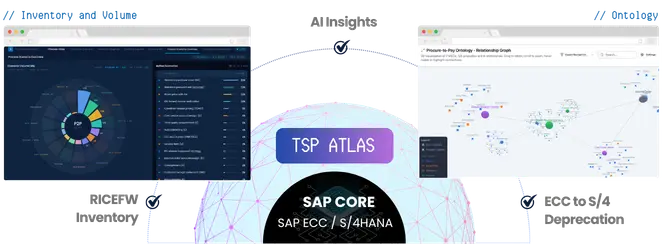
TSP ATLAS delivers four artefacts — a process inventory, volumetric heatmap, RICEFW and Clean Core analysis, and an S/4HANA migration roadmap.
ATLAS is the intelligence engine behind TSP’s SAP S/4HANA pre-migration assessment. Unlike generic process mining platforms, ATLAS is built around SAP’s RICEFW and Clean Core extensibility model — engineered by SAP practitioners, for SAP estates.
BUILT IN
Every Report, Interface, Conversion, Enhancement, Form, and Workflow — counted, scored, and modernisation-flagged per module.
Every ECC process mapped to its S/4HANA equivalent — deprecated, replaced, or architecture-review flagged before you begin.
AI-generated executive insights and recommended management focus — written on top of every analytical view in the platform.
Transaction-level analysis that surfaces usage intensity, user distribution, and business unit ownership beneath each process.
WHY ATLAS
The most common tools organizations encounter when planning S/4HANA assessment are SAP Signavio Process Insights and general process mining platforms. TSP ATLAS differs from both in three fundamental ways: it is purpose-built around SAP’s RICEFW and Clean Core model (generic platforms are not), it delivers inside two weeks at a fixed Phase 0 fee rather than requiring a six-figure annual license, and it is sized for the assessment-first buyer rather than already-funded transformation programs. Most S/4HANA roadmaps are drawn from interviews, benchmarks, and consultant memory – anything but the system you’re actually trying to transform.
TSP ATLAS takes a deep dive into your SAP system and provides a dashboard with four artefacts for a prioritized S/4HANA roadmap and everything you need mapped out for a risk-free S/4HANA migration.
| Conventional approach Generic process mining | TSP ATLAS Live system of records |
|---|---|
| Industry benchmark process libraries | Live, system-of-record analysis from your SAP |
| No native RICEFW or ECC-deprecation lens | Built around RICEFW, Clean Core, and ECC → S/4 |
| Multi-month deployment programmes | Deployed and delivering inside two weeks |
| Six-figure annual platform licenses | Fixed-fee Phase 0 assessment — no annual lock-in |
| Generic — not built for SAP’s clean core model | Engineered by SAP practitioners, for SAP estates |
| Built for already-funded transformation budgets | Sized for the assessment-first, decision-first buyer |
ATLAS is a Phase 0 tool — it is designed to run before a migration programme is funded, not during it. The right moment is when your organization is moving from “should we migrate?” to “how do we scope and price this correctly?” ATLAS gives leadership the evidence to answer that second question without relying on consultant interviews, benchmark data, or assumptions about system complexity.
Specifically, run ATLAS when:
TSP’s free Phase 0 readiness call is the entry point — a 30-minute conversation with a senior TSP delivery leader to understand your landscape and determine whether ATLAS is the right next step. No pre-reads, no pitch.
What is TSP ATLAS and how does it work?
TSP ATLAS is a SAP process intelligence tool that connects in read-only mode to your live ECC system. It auto-discovers every active business process, RICEFW object, and ECC-to-S/4HANA deprecation across all modules — without requiring manual interviews or benchmark data. ATLAS delivers four artefacts in under two weeks: a live process inventory, a volumetric heatmap weighted by transaction volume and user distribution, RICEFW and Clean Core findings, and a prioritized S/4HANA migration roadmap.
How is TSP ATLAS different from SAP Signavio Process Insights?
SAP Signavio Process Insights is a general process mining platform designed for ongoing process monitoring and optimization. TSP ATLAS is purpose-built for the S/4HANA migration decision: it maps ECC processes directly to S/4HANA equivalents, flags deprecated transactions, scores each module by business criticality and modernization priority, and is sized for a fixed-fee Phase 0 assessment rather than a six-figure annual platform license. ATLAS is engineered specifically around SAP’s RICEFW and Clean Core extensibility model — Signavio is not.
Is TSP ATLAS safe to connect to our production SAP system?
Yes. ATLAS operates in read-only mode and extracts metadata only — it does not access transactional data, financial records, or sensitive business information. It is delivered via a SAP transport deployed within your own landscape. The output is an interactive web-based report your team can view and share. No third-party cloud storage of your system data is involved.
Which SAP modules does ATLAS cover?
ATLAS covers all major SAP ECC modules including FI, CO, SD, MM, PP, WM, QM, PM, and HR. For each module, it delivers active process counts, RICEFW object inventory scored by business criticality and complexity, ECC-to-S/4HANA deprecation flags, and transaction-level volume and user distribution data. Each module is given a Business Criticality score, a Complexity score, and a Modernization Priority rating.
How quickly is TSP ATLAS deployed and what do we receive?
ATLAS is typically deployed and delivering insights within two weeks of engagement start. At the end of the Phase 0 engagement, your team receives: (1) a live process map with active process inventory by module, (2) a volumetric heatmap showing transaction volume, frequency, and user distribution, (3) RICEFW and Clean Core findings with a modernization flag per object, and (4) a prioritized S/4HANA migration roadmap your steering committee can use to fund and scope Phase 1.
Can TSP ATLAS be used for S/4HANA release upgrades, not just migrations?
Yes. ATLAS is applicable to organizations already on S/4HANA who are planning a release upgrade. In that context, ATLAS identifies which processes and custom enhancements are affected by new deprecations or simplification items in the target release — enabling a risk-aware upgrade plan. This is particularly valuable for organizations on older S/4HANA releases (1909, 2020) planning to upgrade to 2023 or later.
Read-only access to your SAP environment. A working session at the end with TSP’s SAP architects. You leave with the artefacts your steering committee needs to fund Phase 1 — a live process map, a volumetric heatmap, RICEFW and Clean Core findings, and a prioritised S/4HANA roadmap your team can act on Monday morning.