




shiny particles pass through the glass in a seamless stream

Agentic automation

Agentic automation, from first pilot to enterprise scale

TSP designs, builds and governs AI agents that work across your enterprise systems, SAP included. Agents read documents and resolve exceptions, robots carry out the fixed steps, and your people approve what matters. A first pilot goes live in 6 to 8 weeks.

Already running UiPath bots? See managed services

Agentic automation combines AI agents, software robots and people in one governed process. The Silicon Partners (TSP), a UiPath Diamond Partner and SAP Gold Partner, designs, builds and runs agents for finance, order-to-cash, supply chain and master data, with human approval, full audit trails and verified write-back to SAP.

  • 1,200+Intelligent automations
  • 1M+Hours saved
  • 1,000+Professionals
  • 10xFaster Processes
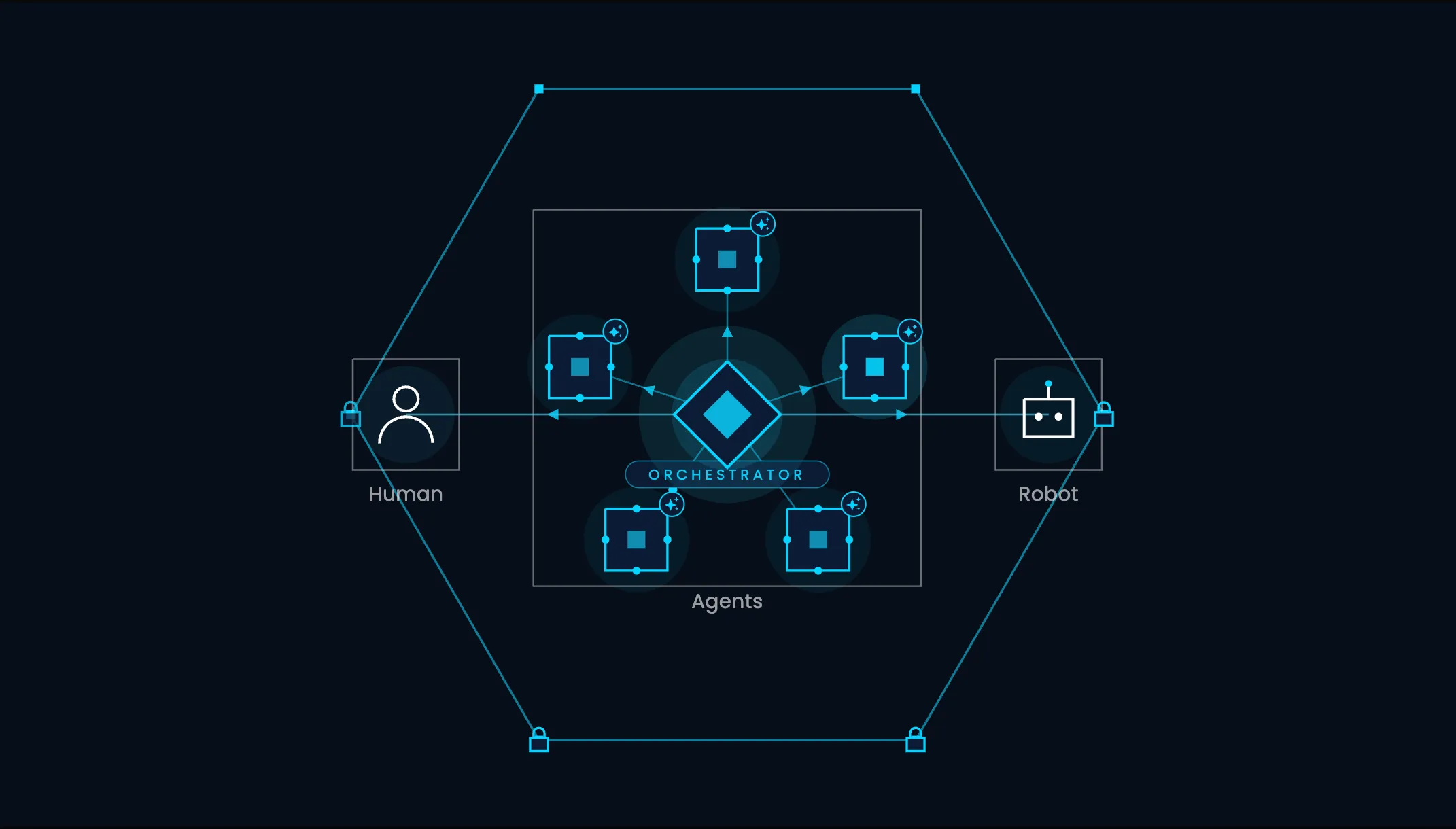
Orchestration loop with agents humans and robots working together

What we do

What TSP builds, orchestrates and governs

One team for the whole lifecycle, from finding the right use case to governed agents running inside SAP.

TSP builds the agents itself, from the first use case to production, and grounds each one in your own processes and data.

What we do

  • Use case discoveryCandidate processes scored for value, with the right level of autonomy set for each step
  • Low-code and pro-code agentsBuilt on UiPath, or in frameworks such as LangChain and the OpenAI Agents SDK when they fit better
  • Document processingInvoices, purchase orders, remittances, certificates and statements read in any layout
  • Grounding in your knowledgeAgents answer from your policies, procedures and SAP data, using retrieval-augmented generation
  • Evaluation and tuningAgent memory, evaluation and prompt optimization, tested before every change

What you get

  • Agents designed around your processes and data
  • A first pilot live in 6 to 8 weeks

Agents, robots and people work through one governed workflow, so each step goes to whoever handles it best.

What we do

  • Multi-agent orchestrationAgents and robots coordinated on UiPath Maestro, including agents built in other frameworks
  • Task routingEach step assigned to an agent, a robot or a person
  • Context across stepsWork keeps its state and history as it moves through a multi-step process
  • Exceptions and escalationClear routes for anything the agents shouldn’t decide alone
  • Process redesignProcesses rethought for agents, with steps removed where they no longer add value

What you get

  • One workflow from document to posting
  • People involved exactly where they add value

Governance is what makes agents presentable to a board: clear limits, human approval and a record of every decision.

What we do

  • Human approvalCheckpoints in UiPath Action Center for anything above the limits you set
  • Policy engineExplicit rules for what each agent can and can’t do
  • Audit trailEvery action and the reasoning behind it, recorded for finance and compliance sign-off
  • SecurityZero-trust design, role-based access and identity management
  • ObservabilityLive dashboards, SLA monitoring and exception reporting

What you get

  • Agents your auditors can follow
  • Risk kept within limits your business sets

Integration is where most agentic programs stall, and it’s where TSP is strongest: agents work inside SAP at transaction level.

What we do

  • SAP at transaction levelECC, S/4HANA and RISE with SAP, through APIs where they exist and screens where they don’t
  • Verified write-backEvery posting checked once it’s written to SAP
  • Across your landscapeSAP Ariba, SAP C4C, SharePoint, Microsoft 365, and banking and government portals
  • Beyond SAPSalesforce, ServiceNow and cloud platform connections

What you get

  • Agents that finish the job inside SAP
  • One team that knows both SAP and automation

SAP process automation

How it works

From first use case to agents in production

  1. Discover and score

    We map candidate processes, score each one on value and feasibility, and decide how much autonomy each step should have. Sometimes the honest answer is that a robot alone is enough.

  2. Design the split

    Each step gets an owner: an agent, a robot or a person. We write the agent’s instructions, set the policy limits it works within and mark the points where a person approves.

  3. Build and ground

    We build agents in low-code or pro-code, read documents with UiPath’s document processing, and ground each agent in your policies and data so its answers come from your sources.

  4. Pilot in 6 to 8 weeks

    A first agent goes live on real work in 6 to 8 weeks, tested against real examples, edge cases and SAP regression tests before it touches production.

    SAP test automation

  5. Govern, measure and scale

    Approvals run through Action Center, every decision is logged with its reasoning, and ROI is measured within 90 days, before the next process is added.

    RPA managed services

Agents in build or production

Agents already live at our clients

  • Finance and accounting

    Invoice processing, cash application, AP credit identification, deductions, credit checks and service invoice reconciliation.

    How they work

  • Month-end close

    GR/IR reconciliation and clearing, vendor reconciliation, deliveries and goods issue, collective billing and FX revaluation.

  • Order-to-cash and supply chain

    Sales orders from any channel, vendor onboarding, material intake, PO expediting and rotables refurbishment.

  • Master data and compliance

    Material master cleanup, data cleansing and claims verification, with stewards approving low-confidence cases.

  • HR and employee services

    An HR policy and PTO assistant that answers employees from your own policies.

  • SAP lifecycle

    TSP’s own agents for SAP programs: TSP ARIA, TSP ATLAS, agentic testing and the Intelligent SAP Basis Robot.

    TSP ARIA

UiPath Diamond Partner

Built on UiPath, open to the frameworks you use

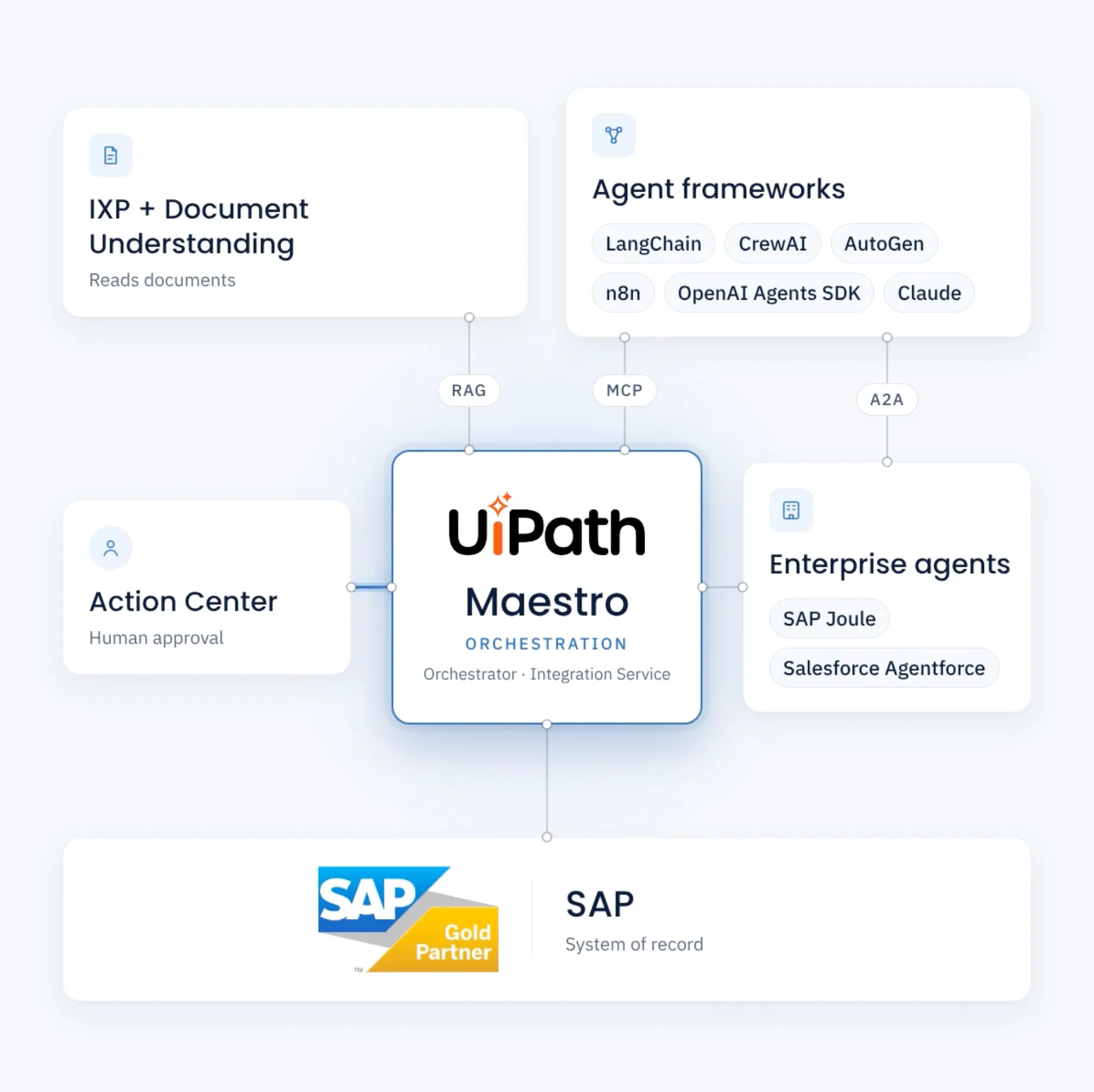
Our agents run on the UiPath platform: Maestro for orchestration, Action Center for approvals, IXP and Document Understanding for documents, and Orchestrator and Integration Service for operations.

  • Agent frameworks: LangChain, LlamaIndex, OpenAI Agents SDK, CrewAI, AutoGen, n8n and Anthropic’s models
  • Enterprise agents: SAP Joule and Salesforce Agentforce
  • Standards: retrieval-augmented generation (RAG), Model Context Protocol (MCP) and agent-to-agent (A2A) communication

TSP is also an SAP Gold Partner, so the team designing your agents understands the SAP system they work in.

Where do you actually need agents?

Agents belong wherever work stalls today: documents that arrive in changing layouts, exceptions waiting for a decision, and emails re-keyed into SAP by hand. Robots stay the right tool for fixed steps on structured data. Most SAP processes use both, with people approving what carries business risk.

Robots are enough when

  • The steps are the same every time
  • Data arrives structured, from SAP screens or fixed-format files
  • The rules rarely change
  • Volume is high and mistakes are costly

An agent earns its place when

  • Invoices, orders or emails arrive in layouts that keep changing
  • Your bots stop and hand work back to people
  • Exceptions sit in a queue waiting for someone to decide
  • Someone re-keys information from PDFs or emails into SAP

Not sure which you need? Map one process with us on a free call.

Read: Robots vs. agents

Customer stories

Agents at work for TSP clients

An Agribusiness executive overlooking farmlands from her office

Agribusiness and CPG · Grower-owned cooperative · United States

6,000+hours saved per year

Ten production automations on SAP S/4HANA, from deductions posting to export paperwork.

Read the full story

Supply officer checking deliveries with a tablet in the supply yard of an open-pit mine

Mining · Global mining company · Worldwide

50%fewer GR/IR discrepancies

A bot sorts GR/IR discrepancies into three categories and emails vendors and buyers by category, cutting discrepancies by 50%.

Read the full story

Hands sorting supplier statements on a desk in a mine site office overlooking an open pit

Mining · Global enterprise · Worldwide

$40M+recovered in the first 9 months

Thousands of vendor statements read and checked automatically, so analysts work only the discrepancies.

Read the full story

Rows of eyeglass frames on a wall display in a bright optical store

Insurance · Large vision benefits provider · United States

178,000+out-of-network claims automated in 6 months

Robots process out-of-network claims and a validation agent checks their work, so people see only the issues.

Read the full story

Scientist working at a biosafety cabinet in a bright biotech research lab

Life sciences · Genetic medicines company · United States

End to endrequisition updates automated in SAP ERP

Requisition data read from Smartsheet, entered and documented in SAP ERP, and status shared with stakeholders automatically.

Read the full story
An Agribusiness executive overlooking farmlands from her office

Agribusiness and CPG · Grower-owned cooperative · United States

6,000+hours saved per year

Ways to start

Start where you are

  • Usual first step

    Free automation call

    Duration
    30 minutes
    Cost
    Free

    What you get

    A senior automation architect’s view on where agents fit in your SAP processes.

  • Agent pilot

    Duration
    6 to 8 weeks
    Cost
    Fixed fee, scoped to one process

    What you get

    One agent live on real work, with its ROI measured within 90 days.

  • Automation health check

    Duration
    2 to 4 weeks
    Cost
    Fixed fee, scoped to your bot estate

    What you get

    A clear view of fragile bots, license use and what to fix, retire or rebuild.

Key questions

What SAP leaders ask about agentic automation

  • Why do our bots keep breaking, and do we have to replace them?

    Bots usually break because a screen, a process or an SAP release changed and nobody updated them. You don’t need to replace them to use agents. A health check finds the fragile ones, and many processes keep their robots for the fixed steps while agents take on the judgment calls that caused the failures.

    See RPA managed services

  • How do we govern AI agents in finance and other regulated processes?

    Give every agent written instructions, policy limits on what it may change in SAP, and a person who approves anything above those limits in Action Center. Log every action with the reasoning behind it so auditors can follow it, and test agents before each change. That is what makes agents presentable to a board.

    Read: The agentic AI governance gap

  • How do we prove the ROI to our CFO?

    Measure the process before anything is built: cost per transaction, cycle time, exception rate and the share of items handled with no person involved. TSP pilots go live in 6 to 8 weeks, and ROI is measured within 90 days on the same volumes, so the CFO sees the change in figures the business already trusts.

    SAP process automation

  • UiPath, SAP Build Process Automation, SAP Joule or another framework?

    Most SAP-centric companies end up using more than one. SAP Build Process Automation and Joule suit work that stays inside SAP’s own applications. Frameworks like LangChain suit specialized agents. UiPath ties them together with orchestration, approvals and robots that act across SAP and other systems. TSP builds on all of them, so the advice follows your processes.

  • Why do so many agentic AI projects stall?

    The same few reasons come up again and again: a process chosen because it demos well, no baseline to prove value, unclear ownership of the agent’s decisions, and no plan for running it after go-live. Starting with one measured pilot, clear approval points and a team responsible for operations avoids most of them.

    Read: Agentic AI architecture

  • Can our own people build automations?

    Yes, with the right guardrails. TSP’s citizen developer training teaches business users to build simple automations with UiPath’s low-code tools, while your center of excellence keeps standards, security and reuse under control. It suits the long tail of team-level tasks that never reach the top of IT’s list.

FAQ

Questions about Agentic automation

Straight answers to what SAP leaders ask us most.

Talk to an SAP expert

What is agentic automation?

Agentic automation is the combination of AI agents, software robots and people working through one orchestrated process. Agents handle steps that need judgment, such as reading documents or resolving exceptions, robots carry out rule-based steps, and people approve the decisions that carry risk. UiPath’s platform is built around this model.

How is agentic automation different from RPA?

RPA uses software robots to follow fixed rules on structured data and screens, such as posting a matched invoice, and it stops when something unexpected happens. Agentic automation adds AI agents for the steps that need judgment, like reading an invoice in a new layout or an email that doesn’t fit the rules; they adapt within their instructions, with guardrails, logs and human review. Robots stay part of the process, carrying out the steps the agents decide on, and people approve the decisions that carry business risk and set the rules both work within. See where agents fit above.

How long does it take to get a first agent into production?

A TSP pilot puts a first agent on real work in 6 to 8 weeks, including discovery, build, testing and the approval steps. ROI is measured within 90 days of go-live. Further processes reuse the same orchestration, governance and SAP connections, so each one after the first gets quicker to deliver.

Does agentic automation work with SAP ECC as well as S/4HANA?

Yes. Agents work with ECC, S/4HANA and RISE with SAP, through SAP’s APIs where they exist and through SAP GUI or Fiori screens where they don’t. If a move to S/4HANA is coming, we build with it in mind so your automations need as little rework as possible. See SAP process automation.

Is it safe to let AI agents act in SAP?

It can be, with the right design. Agents work under a technical user with only the authorizations their process needs, anything above your thresholds waits for a person’s approval, and every posting is checked after it’s written back to SAP. Every action and decision is logged, with the reasoning behind it.

What does it mean that TSP is a UiPath Diamond Partner?

Diamond is the highest of the tiers in UiPath’s partner program, above Platinum and Gold. It reflects the size of a partner’s UiPath practice, its technical expertise and its delivery record. TSP also holds SAP Gold Partner status, so one team covers both the automation and the SAP system it runs in.

Next step

Talk to us about agentic automation

Thirty minutes with a senior automation architect on your SAP processes and the bots you run today. You leave knowing where agents fit and what a pilot would look like.

A senior SAP architect replies within one business day.

By sending this form, you agree to our Privacy Policy.

What happens next

  1. You tell us about your processes and current automation
  2. We point out the processes with the clearest payback
  3. If it makes sense, we scope a pilot or a health check