




Blank glass pages drifting through dark blue space, dissolving into a stream of light that flows into a glowing lattice

Agentic automation

SAP process automation with AI agents

Invoices, payments, sales orders and month-end tasks still pass through too many hands. TSP builds agents that do that work in SAP at transaction level, with your team approving the exceptions.

TSP uses AI agents and software robots to automate SAP work such as invoice processing, cash application, sales order entry, month-end reconciliation and master data cleanup. Agents read documents and make the judgment calls, and robots or APIs post the results. The Silicon Partners (TSP) builds and governs these agents for finance, order-to-cash and supply chain teams.

  • 1,200+Intelligent automations
  • 1M+Hours saved
  • 10xFaster Processes
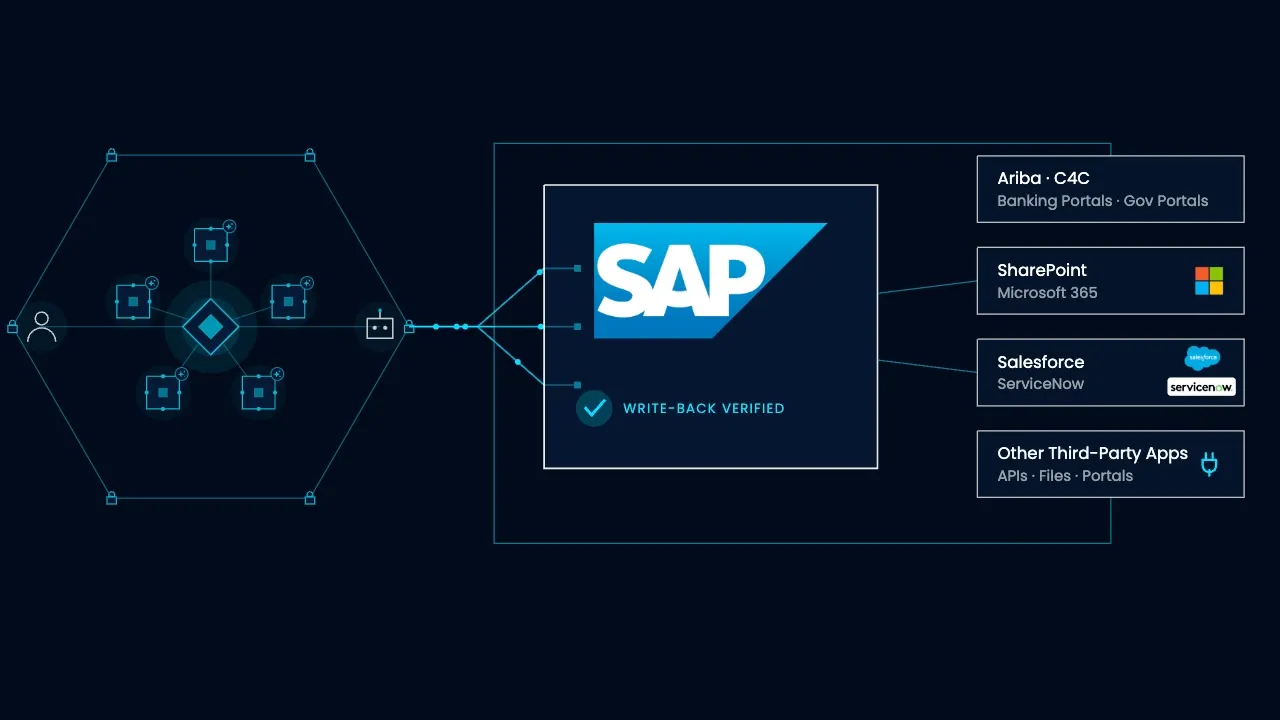
AI agents working with SAP and other third-party apps

By business function

Where our agents work in SAP

Pick a function to see the agents TSP builds for it and what changes for your team.

Orders, credit, invoices and payments decide how fast revenue becomes cash. Agents take on the entry, checks and matching, so your team can focus on exceptions and customers.

The agents

  • Sales order processingOrders from email, PDF, EDI or portals, validated four ways and created in SAP
  • Credit checksExposure checked on every order, with over-limit orders held for review
  • Cash applicationRemittances classified and payments applied to open invoices or posted on account
  • DeductionsShort payments matched to invoices, promotions or claims and posted, with disputes routed to AR
  • Collective billingThe billing due list run on schedule, with every document checked

What changes

  • Orders reach SAP the day they arrive
  • Cash applied every day, with fewer unapplied payments
  • Fewer order errors for customer service to fix

See the sales order flow

Month-end close repeats the same reconciliations every month. Agents prepare them, flag what doesn’t match and leave a record your controllers can review before sign-off.

The agents

  • GR/IR reconciliationReceived, invoiced, variance and aging calculated, and every discrepancy sorted by type
  • Vendor reconciliationVendor statements compared with SAP balances, with the explanation email drafted
  • GR/IR clearingMatched documents cleared and open credit balances flagged for review
  • FX revaluationForeign currency valuation run as a test, validated, then updated

What changes

  • Reconciliations ready at the start of close
  • Every difference explained and documented
  • A full audit trail for each adjustment

Invoices, vendors and purchase orders create more paperwork than anything else in finance. Agents read every document, match it in SAP and chase what’s missing.

The agents

  • Invoice processingInvoices read in any layout, three-way matched and posted, with exceptions routed
  • Vendor onboardingSupplier documents collected and checked, and vendor records created for approval
  • PO expeditingSuppliers asked to confirm orders and late deliveries, with their answers logged in SAP
  • AP credit recoveryVendor statements read for credits owed, with follow-up emails drafted
  • Service invoice reconciliationService invoices checked against the work recorded and the contract

What changes

  • More invoices posted with nobody touching them
  • Vendor credits found and recovered
  • Suppliers followed up automatically, with replies in SAP

Materials, deliveries and repairs keep operations moving, and each one depends on accurate SAP data entered on time.

The agents

  • Material intakeReceipts and their documents captured, checked and posted
  • Rotables refurbishmentRepair and refurbishment paperwork tracked through every step
  • Deliveries and goods issueMonth-end deliveries, picking and goods issue run on schedule

What changes

  • Stock in SAP matches the warehouse sooner
  • Repairs and returns tracked from start to finish
  • Fewer manual postings at month-end

Duplicate and incomplete records quietly break planning, purchasing and reporting. Agents find them, fix them safely and keep evidence for every change.

The agents

  • Material master cleanupDuplicates grouped, the best record kept and every dependency checked first
  • Data cleansingRecords checked against your rules, then corrected or flagged
  • Vendor and customer changesRequests collected, validated and updated with an audit trail

What changes

  • Planning runs on one record per material
  • Cleaner data before a move to S/4HANA
  • Data stewards approve only the uncertain cases

Employees ask HR the same policy questions every day, and HR teams repeat the same SuccessFactors steps.

The agents

  • HR policy and PTO assistantAnswers employees from your own policies, with the source for every answer
  • SuccessFactors processesBulk offers, onboarding steps and document checks automated

What changes

  • Employees get answers in seconds
  • HR spends less time on repeat requests
  • Every answer points to the policy behind it

Basis teams spend hours on refreshes, transports and checks that follow the same steps every time.

The agents

  • System copies and refreshesPre- and post-steps run by the Intelligent SAP Basis Robot
  • Transport managementTransports moved and checked through your landscape
  • Job and batch monitoringDaily checks run, with failures flagged to the team
  • User and role administrationRoutine requests handled under your approval rules

What changes

  • Refreshes finish on schedule
  • Every step documented with screenshots for compliance
  • Your Basis team keeps the decisions

Use case: sales order processing

How an agent turns a purchase order into a sales order

  1. Capture from every channel

    Orders arrive by email, PDF, EDI 850 or customer portal. UiPath IXP extracts the customer, ship-to address, materials, quantities and units, whatever the format.

  2. Validate four ways

    Agents check the sold-to against SAP business partners, the ship-to against delivery addresses, each material against info records, and every unit of measure against your conversion table.

  3. Check credit

    The order is checked against the customer’s credit exposure. Orders within limit continue; orders over limit, or customers on mandatory hold, are held for credit review.

  4. Resolve the small stuff

    Agents fix unit-of-measure mismatches, merge duplicate POs and correct rounding within the rules you set. Hard exceptions, or anything below the confidence threshold, go to a person in UiPath Action Center.

  5. Create and confirm

    The order is created in SAP through its API, and the customer gets a confirmation email. Every check, decision and approval is logged.

Key questions

What SAP teams ask about process automation

  • How do agents help close the month in SAP?

    Agents take on the close tasks your team repeats every month: reconciling GR/IR and vendor accounts, clearing matched items, running deliveries and collective billing, and revaluing foreign currency balances. Each task follows your rules, flags what doesn’t reconcile, and leaves a record your controllers review before sign-off.

    See the month-end agents

  • Can an agent clean up our SAP material master?

    Yes, and safely. TSP’s cleanup agent groups likely duplicates, confirms them through several similarity checks and keeps the most complete record. It checks every planned order, requisition and purchase order before changing anything, and sends uncertain cases to a data steward. Cleaning up before a move to S/4HANA means less data to convert.

    See the master data agents

  • How do we prove the ROI of SAP automation to the CFO?

    Build the case on your own numbers. Before anything is built, TSP measures the process as it runs today: volumes, handling time, exception rates and cost per transaction. A pilot goes live in 6 to 8 weeks, and the same measures are taken within 90 days on the same volumes, so the CFO sees figures the business already trusts.

    Ask about a pilot

  • Can SAP Basis work be automated?

    Much of it can. TSP’s Intelligent SAP Basis Robot handles the repetitive parts of system copies and refreshes, plus transports, job monitoring and routine checks, and documents every step with screenshots for your compliance records. Your Basis team keeps the decisions and gets back the hours spent on routine work.

    See the Basis agents

  • What happens to our SAP automation when we move to S/4HANA?

    Plan for it early. Automations built against ECC screens often break when transactions, fields or screens change in S/4HANA. TSP takes an inventory of your automations during migration planning, decides which to retire, rebuild or move to APIs, and tests them against the new system, so operations keep running after cutover.

    How a TSP migration runs

Ways to start

Start where you are

  • Usual first step

    Free automation call

    Duration
    30 minutes
    Cost
    Free

    What you get

    A senior automation architect’s view on which SAP processes to automate first.

  • Agent pilot

    Duration
    6 to 8 weeks
    Cost
    Fixed fee, scoped to one process

    What you get

    One agent live on real SAP work, with its ROI measured within 90 days.

  • Ready-to-deploy agent

    Duration
    Weeks, depending on fit
    Cost
    Fixed fee, configured to your system

    What you get

    A pre-built agent for a standard process, fitted to your SAP setup.

Customer stories

SAP automation in production

An Agribusiness executive overlooking farmlands from her office

Agribusiness and CPG · Grower-owned cooperative · United States

6,000+hours saved per year

Ten production automations on SAP S/4HANA, from deductions posting to export paperwork.

Read the full story

Supply officer checking deliveries with a tablet in the supply yard of an open-pit mine

Mining · Global mining company · Worldwide

50%fewer GR/IR discrepancies

A bot sorts GR/IR discrepancies into three categories and emails vendors and buyers by category, cutting discrepancies by 50%.

Read the full story

Hands sorting supplier statements on a desk in a mine site office overlooking an open pit

Mining · Global enterprise · Worldwide

$40M+recovered in the first 9 months

Thousands of vendor statements read and checked automatically, so analysts work only the discrepancies.

Read the full story

Rows of eyeglass frames on a wall display in a bright optical store

Insurance · Large vision benefits provider · United States

178,000+out-of-network claims automated in 6 months

Robots process out-of-network claims and a validation agent checks their work, so people see only the issues.

Read the full story

Scientist working at a biosafety cabinet in a bright biotech research lab

Life sciences · Genetic medicines company · United States

End to endrequisition updates automated in SAP ERP

Requisition data read from Smartsheet, entered and documented in SAP ERP, and status shared with stakeholders automatically.

Read the full story
An Agribusiness executive overlooking farmlands from her office

Agribusiness and CPG · Grower-owned cooperative · United States

6,000+hours saved per year

FAQ

Questions about SAP process automation

Straight answers to what SAP leaders ask us most.

Talk to an SAP expert

Which SAP processes should we automate first?

Start where volumes are high, the work follows rules most of the time, and exceptions eat your team’s day. Invoice processing, cash application and sales order entry usually qualify. Want a faster start on a standard process? Our pre-built bots and agents are ready to configure.

Do AI agents post directly in SAP?

They can, within limits you set. In most designs the agent decides and an API or robot posts, under a technical user with only the authorizations that process needs, and the posting is checked once it’s written back. Anything above your thresholds waits for a person. Once live, TSP can run the agents for you through RPA managed services.

Can UiPath automate SAP GUI and SAP Fiori?

Yes. UiPath automates both SAP GUI and SAP Fiori screens and also connects through SAP’s APIs. Where an API exists, TSP uses it, because it’s faster and holds up better when screens change. Screen automation in SAP GUI needs SAP GUI scripting switched on, which your Basis team controls.

What is intelligent document processing?

Intelligent document processing uses AI to classify documents and pull out their data, such as invoice lines, remittance details or order items, so automation can work with it. UiPath’s version is called IXP. It passes the extracted data to robots and agents, and sends fields it isn’t sure about to a person to confirm.

Do you automate SAP ECC as well as S/4HANA?

Yes, including RISE with SAP. Most agents work on both, and many companies automate on ECC while they plan their move. If a migration is coming, we design automations so they need as little rework as possible when you switch.

Next step

Talk to us about automating SAP processes

Thirty minutes with a senior automation architect on the SAP processes that take your team the most time. You leave knowing which to automate first.

A senior SAP architect replies within one business day.

By sending this form, you agree to our Privacy Policy.

What happens next

  1. Tell us a little about your SAP landscape and what you aspire for
  2. A senior SAP architect and agentic AI expert reviews it before we talk
  3. We meet, and you leave with an honest view and clear next step